The Neuroscience of Flow State: Brainwave Patterns and Neurochemical Signatures
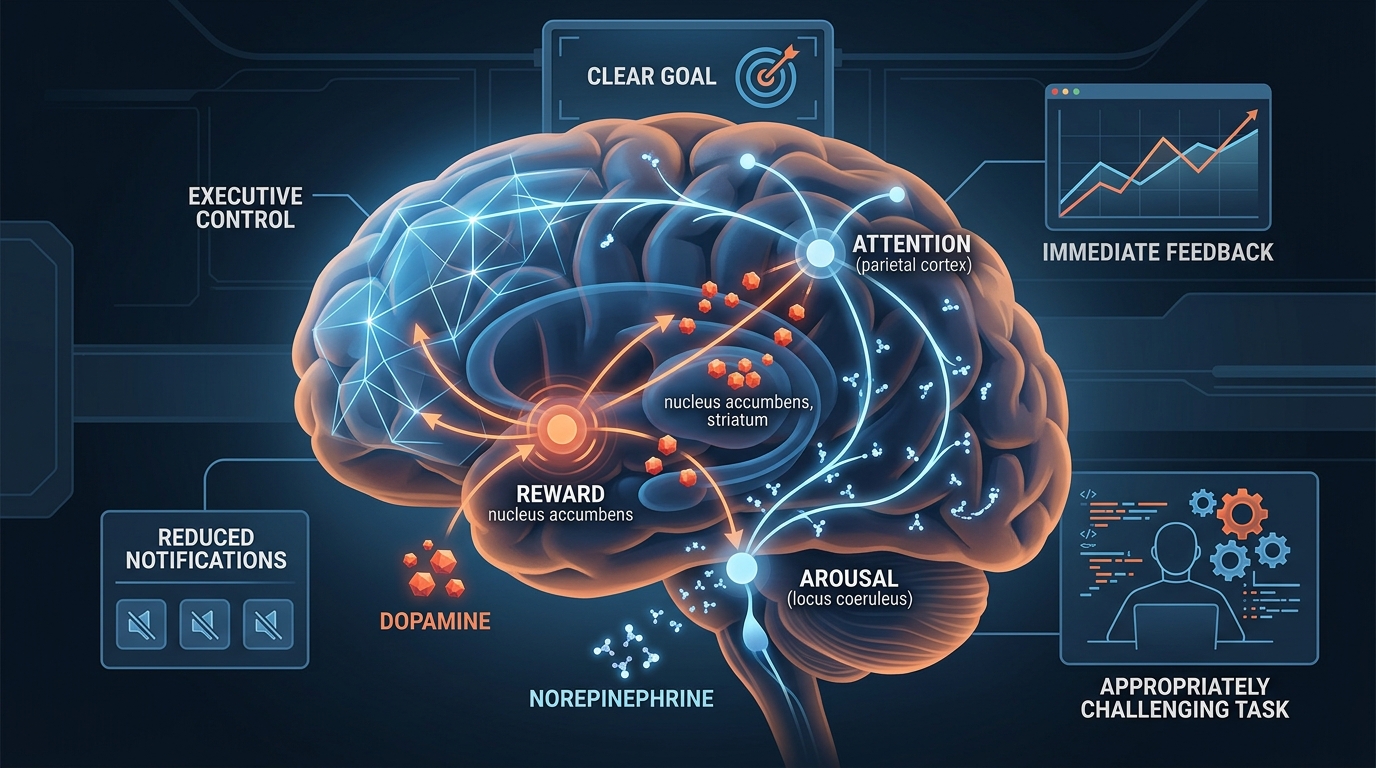
Flow is often described as being “in the zone”: attention narrows, action feels unusually fluid, self-conscious commentary fades, and time may seem compressed. That description is psychologically familiar, but the neuroscience is much less settled than popular summaries imply. Researchers have identified recurring patterns in electroencephalography, functional brain imaging, autonomic arousal, and reward-related circuitry, yet no single brainwave, brain region, or neurotransmitter has been validated as a universal “flow switch.” The most defensible account is a systems-level one: flow appears when attention, cognitive control, reward valuation, skilled automaticity, and arousal are coordinated well enough for a demanding task to feel manageable and intrinsically engaging.
This distinction matters because the phrase The Neuroscience of Flow State: Brainwave Patterns and Neurochemical Signatures can invite overly tidy conclusions. Brainwaves are not labels for mental states, and neurochemicals are not mood buttons. Alpha, theta, beta, and gamma activity change with task demands, sensory processing, fatigue, movement, expertise, and measurement choices. Likewise, dopamine and norepinephrine participate in many forms of motivation and attention that are not flow. A scientifically careful explanation therefore asks what patterns have been observed, how they were measured, what competing interpretations remain possible, and which claims are still theoretical.
A layered view of flow begins with subjective experience, not a single brainwave.
What Scientists Mean by a Flow State
Flow is usually operationalized as a cluster of experiences rather than a single feeling. Common features include intense concentration, a close match between challenge and skill, clear goals, rapid feedback, reduced self-referential thinking, a sense of control, altered time perception, and intrinsic reward. In laboratory research, participants may perform arithmetic, gaming, music, sports, or visuomotor tasks while the difficulty is adjusted to create boredom, overload, and a middle condition intended to promote flow.
The challenge-skill balance is central but not sufficient. A task can be difficult without being meaningful, and it can be engaging without producing the unusual fluency associated with flow. Clear feedback also matters because the nervous system must rapidly estimate whether current actions are working. When errors are interpretable and correction is possible, attention can remain task-centered. When feedback is delayed, ambiguous, or socially threatening, self-monitoring and uncertainty may consume resources that would otherwise support smooth performance.
Researchers also distinguish state flow from trait-like tendencies. State flow refers to a temporary episode during a particular activity. Trait or dispositional flow refers to how often a person reports such episodes across contexts. The distinction is important because a neural measure recorded during one arithmetic task cannot automatically explain a musician’s improvisation, an athlete’s movement, or a programmer’s sustained problem solving. Expertise, task structure, body movement, and motivation can all change the observed signal.
- Challenge: The task must require real effort without producing persistent failure.
- Skill: The person needs enough practiced capacity to act without consciously rebuilding every step.
- Feedback: The task should reveal progress quickly enough to guide correction.
- Attention: Competing demands must be limited so relevant signals win priority.
- Reward: The activity itself must carry enough value to sustain engagement.
EEG Findings: Theta, Alpha, and the Problem of Simple Labels
Electroencephalography, or EEG, records voltage fluctuations at the scalp that reflect synchronized activity from large populations of neurons. It offers excellent timing information but relatively limited spatial precision. Researchers divide the signal into frequency bands, yet those bands are descriptive ranges rather than discrete mental programs. “More alpha” does not always mean relaxation, and “more theta” does not always mean creativity. Location, timing, task, baseline, and analysis method all matter.
A frequently cited mental-arithmetic study compared boredom, flow, and overload conditions in 16 participants. It reported increased frontal theta with moderate frontocentral alpha during the condition designed to induce flow. Frontal theta was interpreted as consistent with concentrated cognitive control and immersion, while the moderate alpha pattern may have reflected a workload that was substantial but not excessive. Crucially, frontal theta was also elevated in overload, which means theta alone did not uniquely identify flow. The combination of measures carried more information than any single band.
Later work has explored whether prefrontal EEG patterns generalize across multiple tasks, but results remain sensitive to task design and recording method. A single-channel headband, for example, cannot provide the same spatial detail as a laboratory cap with many electrodes. Facial muscles, eye movements, posture changes, and movement artifacts can mimic or obscure neural oscillations. This is especially important in sports, music, and gaming, where natural behavior may generate exactly the kinds of artifacts that are hardest to separate from brain activity.
Alpha activity is particularly easy to oversimplify. Depending on where it appears, alpha can index reduced sensory input, active inhibition of irrelevant information, internally directed attention, or changing memory load. In a flow task, moderate alpha may indicate efficient gating rather than drowsiness. Beta and gamma findings are even less consistent across studies because they are strongly affected by muscle activity and domain-specific processing. The sensible conclusion is not that flow has one frequency, but that flow may involve a task-dependent balance between control, filtering, and automatic skilled processing.
| Signal or system | Possible relevance to flow | Why interpretation is limited |
|---|---|---|
| Frontal theta | Sustained control, concentration, error monitoring, and task engagement | Also rises during overload and difficult non-flow tasks |
| Alpha activity | Filtering distraction, regulating sensory input, and managing working-memory demand | Meaning changes by scalp location, task, and baseline |
| Beta activity | Sensorimotor maintenance and active task processing | Highly vulnerable to jaw, forehead, and neck muscle artifacts |
| Gamma activity | Local integration and complex processing in some paradigms | Scalp gamma is difficult to separate from muscle contamination |
| Pupil and autonomic signals | Arousal, effort, and engagement dynamics | Affected by light, emotion, fatigue, medication, and breathing |
Brain Networks: Control, Self-Reflection, and Skilled Automaticity
Functional MRI does not measure neurons firing directly. It tracks blood-oxygen-level-dependent changes that are statistically related to neural activity. Flow studies using fMRI have reported changes in frontal control regions, reward-related structures, the amygdala, and parts of the default mode network. One influential experiment found relative increases in the left inferior frontal gyrus and putamen, alongside reduced medial prefrontal activity and amygdala activity during a flow condition compared with boredom and overload. The authors interpreted these changes as deeper cognitive control, reward-related processing, less self-referential evaluation, and lower negative arousal.
These findings partly support the idea of transient hypofrontality, which proposes that some explicit, self-monitoring functions of the prefrontal cortex temporarily quiet during highly absorbed performance. However, “the frontal cortex shuts down” is inaccurate. Different frontal regions can move in different directions. Regions supporting task control may remain active or become more active, while medial regions associated with self-focused thought may become less active. Flow may therefore involve selective reconfiguration, not global frontal deactivation.
The default mode network is often discussed because it contributes to autobiographical thinking, mind-wandering, and self-referential processing. Reduced activity in parts of this network could help explain why inner commentary becomes less prominent. At the same time, the executive control network must still coordinate goals, rules, and error correction. The apparent paradox—effortful performance that feels effortless—may be resolved when well-practiced task routines carry much of the moment-to-moment work while higher-level control remains available but less intrusive.
Expertise changes this balance. In a 2024 jazz-improvisation study, high-flow performances were associated with patterns interpreted as optimized domain-specific processing in expert improvisers, together with reduced activity in regions linked to conscious control. The result does not mean novices can bypass practice by “entering flow.” It suggests the opposite: automaticity depends on a rich library of learned patterns that can be deployed with less conscious supervision.
Neurochemical Signatures: What Is Measured and What Is Inferred
Popular descriptions often present a fixed “flow cocktail” of dopamine, norepinephrine, endorphins, serotonin, and anandamide. Direct evidence for such a universal cocktail in humans is not available. Most flow experiments measure behavior, self-report, EEG, fMRI, heart rate, skin conductance, respiration, or pupil size. They generally do not sample neurotransmitter concentrations in the human brain during natural performance. Claims about neurochemicals are therefore built from indirect evidence, known functions of neuromodulatory systems, and theoretical correspondence with the subjective features of flow.

Dopamine is a plausible contributor because it helps regulate reward prediction, motivation, learning, action selection, and the willingness to expend effort. Flow is intrinsically rewarding and often sustains repeated engagement, so dopaminergic circuits are reasonable candidates. Activity in the putamen and other reward-related regions supports that interpretation, but an fMRI signal is not a direct dopamine assay. Dopamine also changes during many non-flow conditions, including anticipation, novelty, successful learning, and some forms of stress.
The locus coeruleus-norepinephrine system offers another useful model. Norepinephrine helps tune arousal, attention, and the tradeoff between exploiting a current task and exploring alternatives. A 2021 review proposed that flow may align with an intermediate-arousal mode in which tonic norepinephrine is neither too low nor too high and phasic responses emphasize task-relevant information. This fits the familiar inverted-U pattern: too little activation favors boredom, while too much favors stress and distractibility. The review explicitly noted that the LC-NE-flow relationship had not yet been directly tested in published flow experiments, so it should be treated as a strong hypothesis rather than a confirmed chemical signature.
Endogenous opioids and endocannabinoids are sometimes proposed because they can influence pain, effort, mood, and absorption, especially during prolonged exercise. Serotonin is discussed because of its broad roles in mood, patience, behavioral flexibility, and cortical regulation. Yet these systems are chemically complex, receptor-specific, and context-dependent. Saying that “serotonin causes flow” or “anandamide creates lateral thinking” goes beyond the evidence. The more accurate statement is that multiple neuromodulators probably help configure the brain state in which focused, rewarding, low-self-conscious performance can occur.
Using stimulants, unregulated supplements, extreme sleep restriction, breath-holding, or compulsive exercise to chase a presumed neurotransmitter surge is not supported by flow research and may impair judgment, sleep, cardiovascular safety, or mental health. Flow is a performance state, not a diagnosis, treatment, or justification for self-experimentation with drugs.
Why the Evidence Does Not Yet Produce a Universal Biomarker
A systematic review of 25 studies involving 471 participants found recurring involvement of attention, executive, reward, and anterior brain systems, but also major inconsistencies across methods and tasks. Its central conclusion was that the evidence remains sparse and inconclusive. Small samples, different flow questionnaires, varied induction methods, inconsistent control conditions, and selective reporting make it difficult to determine whether one neural pattern generalizes across people and activities.
Measurement timing is another problem. Flow can fluctuate from moment to moment, but many studies ask participants to rate an entire block after it ends. A person may report high average flow even though the state came and went. Interrupting a task to ask for ratings can itself break absorption. Researchers therefore face a tradeoff between real-time measurement and preserving the phenomenon they want to observe.
There is also a circularity risk. A task condition may be called “flow” because its difficulty matches skill, and then brain activity in that condition may be labeled a flow signature even when subjective flow is modest. Better studies combine adaptive task design, immediate or minimally disruptive reports, objective performance, physiological measures, and preregistered analysis. They also distinguish flow from concentration, positive mood, expertise, and simple task success.
Consumer devices add another layer of uncertainty. A consumer EEG headband may estimate broad spectral changes, and a heart-rate chest strap may track arousal, but neither can verify flow by itself. A lower heart rate could reflect relaxation, fitness, medication, or measurement error. An alpha estimate could reflect closed eyes, poor electrode contact, or reduced visual input. Personal trends may be interesting, but they are not clinical or scientific proof of a neurochemical state.
Practical Conditions That Make Flow More Likely
The practical value of neuroscience is not a recipe for forcing flow on command. It is a framework for reducing avoidable friction and keeping arousal within a workable range. The most reliable levers are behavioral: define a concrete objective, choose a challenge that is slightly above routine ability, make feedback visible, remove competing cues, and protect enough uninterrupted time for task representations to stabilize.
Environmental tools can support those conditions without becoming the focus. A visual timer can mark a protected work interval without repeated clock checking. Noise-blocking headphones or over-ear hearing protection can reduce unpredictable sound in a noisy setting. An adjustable task light can improve visual comfort, while a paper notebook can hold intrusive reminders so working memory does not have to rehearse them. None of these tools creates flow; they simply reduce unnecessary demands.
The clearest practical lesson is to engineer conditions, not chase a chemical high.
- Write one observable outcome for the session, not a vague intention.
- Choose a task difficult enough to require concentration but not constant rescue.
- Break the first step down until action can begin within two minutes.
- Make feedback immediate through visible progress, test results, repetitions, or completed units.
- Silence nonessential alerts and place the phone outside arm’s reach.
- Use a visual timer for a protected interval, then schedule a deliberate break.
- Keep water available and avoid beginning when severely hungry, sleep-deprived, or overstimulated.
- Capture unrelated thoughts in a paper notebook instead of switching tasks.
- Afterward, record what challenge level, duration, and environment supported concentration.
- Increase difficulty gradually as skill improves rather than seeking constant intensity.
Flow is also more likely after substantial practice because practice compresses complex actions into more efficient routines. This reduces the need to consciously monitor every substep. However, excessive automaticity can produce boredom, so the challenge must evolve. A musician may vary tempo or harmony; a writer may impose a structural constraint; a programmer may tackle a slightly more complex problem. The goal is not maximum difficulty. It is a moving fit between capability and demand.
How to Interpret Your Own Experience Without Overclaiming
People often know they were deeply absorbed only after the episode ends. That retrospective quality makes simple self-tracking useful, as long as it is not mistaken for brain measurement. After a session, rate concentration, perceived control, challenge-skill balance, time distortion, enjoyment, and mental fatigue. Add objective data such as pages revised, errors corrected, repetitions completed, or problems solved. Over several weeks, patterns may emerge.
A brief log is usually more informative than a gadget dashboard. Record the task, start time, sleep quality, interruptions, challenge level, and whether feedback was immediate. If desired, a digital interval timer, a desk sound machine, or blackout curtains may help standardize the environment, but they should be treated as context controls rather than neural enhancers. A sleep eye mask can support rest before the next day, yet better sleep supports cognition broadly; it is not a flow intervention in itself.
Watch for costs. Deep absorption can make people miss meals, postpone movement, ignore pain, or work beyond healthy limits. Time distortion is not always beneficial. In safety-critical work, caregiving, driving, or equipment operation, external reminders and mandatory checks remain essential. Flow should improve flexible performance, not remove appropriate oversight.
It is also important to separate flow from hypomania, compulsive behavior, dissociation, or stimulant-driven overfocus. Flow is typically task-specific, organized around clear feedback, and followed by a coherent sense of accomplishment. If intense focus accompanies very little sleep, racing thoughts, risky decisions, inability to stop, severe distress, or major impairment, the issue deserves professional attention rather than optimization advice.
Frequently Asked Questions
Is alpha the main flow brainwave?
No. Alpha activity has appeared in some flow studies, but its meaning depends on location, task, and comparison condition. Moderate frontocentral alpha combined with frontal theta may distinguish flow from boredom and overload in certain arithmetic paradigms, but alpha alone is not a validated flow marker.
Does theta prove that someone is in flow?
No. Frontal theta often increases during concentration, cognitive control, error monitoring, and difficult tasks. It can rise during overload as well as flow. A useful interpretation requires multiple signals, subjective reports, task performance, and a well-designed control condition.
Is flow caused by dopamine?
Dopamine probably contributes to motivation, reward learning, effort, and action selection during flow, but direct measurement is limited. Flow cannot be reduced to dopamine, and increasing dopamine does not guarantee flow.
What role may norepinephrine play?
Norepinephrine may help regulate arousal and prioritize task-relevant information. The leading hypothesis places flow near an intermediate-arousal mode: enough activation for strong engagement, but not so much that attention becomes scattered or stress-dominated.
Can a wearable EEG device detect flow?
Not reliably as a universal state. Wearables may show personal changes in spectral power, but limited electrodes, movement artifacts, proprietary algorithms, and task differences prevent a simple yes-or-no diagnosis of flow.
Does the prefrontal cortex shut down during flow?
No. Some medial prefrontal regions involved in self-referential processing may decrease in activity, while other frontal regions involved in control can remain active or increase. Selective network reconfiguration is a better description than total shutdown.
Can flow be trained?
The conditions that support flow can be trained: skill development, clear goals, feedback use, attentional control, and challenge calibration. The subjective state itself cannot be guaranteed on demand, and trying too hard to monitor it may interrupt it.
Is flow always healthy?
No. Flow can support learning, creativity, and performance, but deep absorption can also contribute to overwork, missed physical needs, gaming overuse, or unsafe persistence. Healthy boundaries and recovery remain necessary.
Conclusion: A Coordinated State, Not a Single Signature
The neuroscience of flow is best understood as an emerging map rather than a completed mechanism. EEG studies point to combinations of frontal theta and task-dependent alpha activity. Imaging studies implicate control, reward, self-referential, emotional, and sensorimotor systems. Expertise appears to shift the balance toward efficient domain-specific processing with less intrusive conscious supervision. Dopamine and norepinephrine are plausible contributors because they regulate reward, effort, attention, and arousal, but a universal neurochemical recipe has not been directly demonstrated.
The strongest synthesis is therefore relational. Flow seems to arise when challenge matches skill, feedback guides action, practiced routines reduce unnecessary deliberation, relevant information receives priority, and arousal remains high enough for engagement without tipping into stress. The state is dynamic, task-specific, and shaped by expertise. Neuroscience can explain why those conditions matter, but it does not justify a single brainwave score, a supplement stack, or a device claiming to switch flow on.
For practical purposes, the evidence supports disciplined preparation: protect attention, calibrate difficulty, build skill, make feedback visible, and recover well. For scientific purposes, the field still needs larger samples, preregistered analyses, richer real-world tasks, better time-resolved self-report, and multimodal measurement. That combination of usefulness and uncertainty is not a weakness. It is the most accurate picture currently available.


Comments
Post a Comment