Are You Missing This Critical Nutrient for Sharper Memory? The Choline-Brain Connection Explained
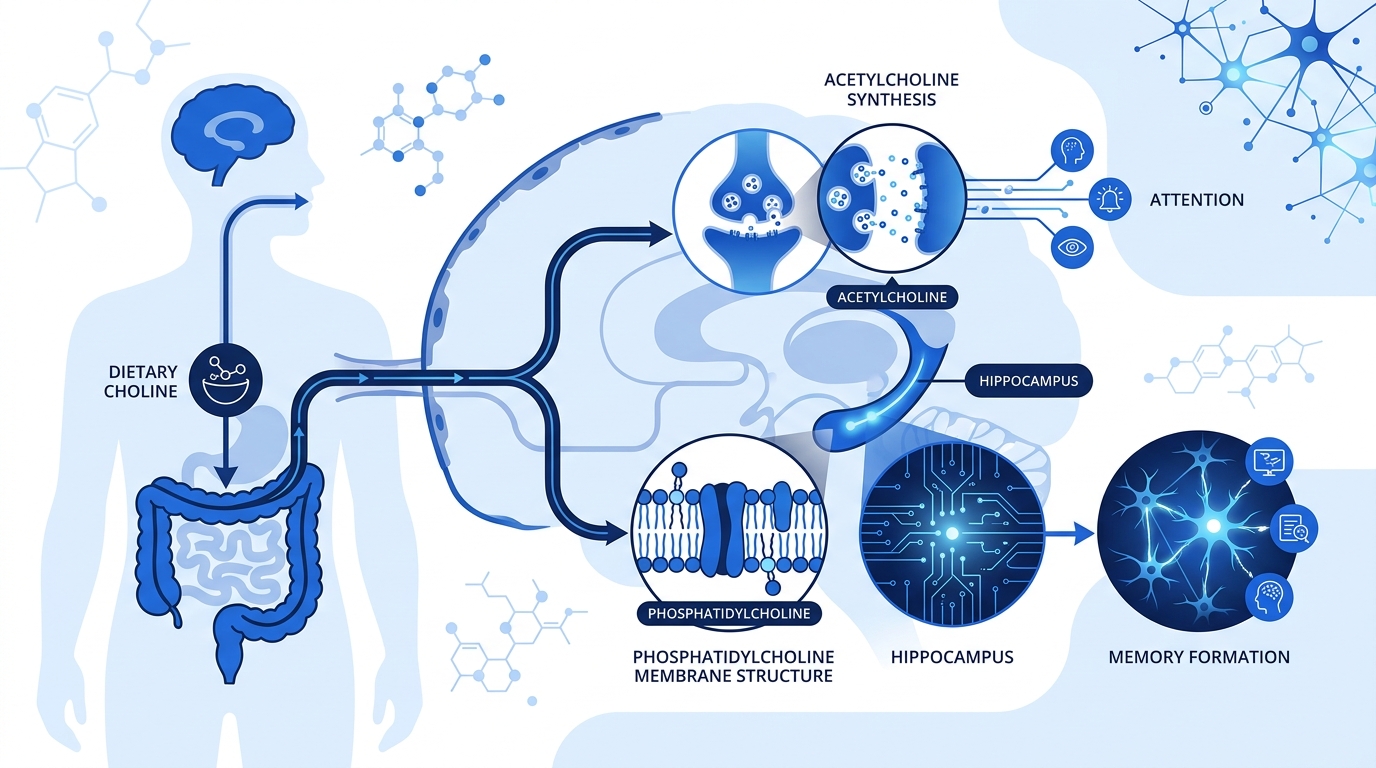
Memory does not run on a single nutrient. But if you are interested in Choline Brain Health, there is a legitimate neuroscience reason to pay attention to choline: it supplies raw material for acetylcholine, a neurotransmitter deeply involved in attention and memory, while also contributing to phosphatidylcholine and other cell-membrane components. That makes choline biologically important to the brain without proving that taking more of it will automatically make an already well-nourished person remember more.
That distinction is the key to understanding the choline-memory connection. A nutrient can be essential for normal physiology while a concentrated supplement produces little or no measurable cognitive benefit in a particular person. The practical question is therefore not simply, “How much choline can I take?” It is, “Am I meeting a reasonable nutritional need, and what evidence exists for changing that level?”
Why Choline Gets Attention in Memory Research
Choline sits at an interesting intersection of nutrition and cognitive neuroscience. It is used to make acetylcholine, a neurotransmitter involved in attention, learning, and several stages of memory processing. Choline is also incorporated into phospholipids such as phosphatidylcholine, which help build and maintain cellular membranes. A separate metabolic route converts choline to betaine, connecting it with one-carbon metabolism and methyl-group transfer.
In other words, choline is not simply a “memory vitamin.” It is a raw material used in several biological systems at once. A review of choline nutrition describes its roles in membrane phospholipids, methyl donation, and acetylcholine production, while noting that liver, eggs, meat, dairy, and grains can contribute substantially to dietary intake. [3]
The memory connection becomes particularly interesting in the hippocampus. Cholinergic neurons densely innervate this region, and research reviews describe acetylcholine as a modulator of hippocampus-dependent learning and memory. [2] That does not mean acetylcholine acts like a simple memory switch. Its effects depend on receptors, timing, brain region, task demands, and the particular stage of memory being examined.
This is why the strongest version of the claim is modest: adequate choline availability supports biological processes that the brain uses for normal function, including cholinergic neurotransmission and membrane maintenance. The weaker and much less defensible claim is that more choline necessarily equals sharper memory.
The Neurotransmitter Link: Choline, Acetylcholine, and the Hippocampus
Acetylcholine is one of the brain's major neuromodulators. Rather than carrying one narrowly defined message, cholinergic signaling can alter how neural circuits process incoming information. Reviews of memory neuroscience describe a role for acetylcholine across acquisition, encoding, consolidation, reconsolidation, retrieval, and other memory-related processes. [1]
The hippocampus is particularly important because it helps organize aspects of episodic and declarative memory. Cholinergic inputs to hippocampal networks can change neuronal responsiveness and the way information is processed during learning. [2] This helps explain why acetylcholine appears repeatedly in discussions of attention and memory.
There is an important counterpoint, however. Acetylcholine's relationship with memory is not linear. One review emphasizes that hippocampal acetylcholine can facilitate some phases of memory while interacting differently with consolidation and retrieval. [2] Another review describes the relationship between acetylcholine and memory as complex and dependent on the memory system and task involved. [1]
That matters when interpreting supplement claims. If a person consumes additional choline, the body has to regulate absorption, distribution, metabolism, transport, and neurotransmitter synthesis. Raising the availability of a precursor does not mean every neuron suddenly produces proportionally more useful acetylcholine at the exact moment needed for learning.
Choline Does More Than Feed Acetylcholine
Focusing exclusively on neurotransmission misses another major part of choline biology: membranes.
Phosphatidylcholine is a major phospholipid in biological membranes. Neurons depend on membrane integrity because receptors, ion channels, transporters, and signaling proteins all operate within or around cellular membranes. Choline-containing phospholipids also participate in intracellular signaling and lipid metabolism. [3]
This creates a second route by which choline can be relevant to brain health. It is not only a precursor for a neurotransmitter; it is also part of the structural and metabolic environment in which neurons operate.
That distinction helps explain why phosphatidylcholine appears in discussions of choline nutrition. Phosphatidylcholine is both a dietary choline-containing compound and a major structural lipid. Research on choline-containing phospholipids has explored whether different compounds influence brain pathways differently, but the evidence is not interchangeable across all forms. [4]
For practical reasoning, this means that “choline” should be treated as a nutrient family with several metabolic destinations rather than as a single-purpose cognitive ingredient.
What the Human Evidence Actually Says About Memory
The evidence becomes more nuanced when we move from mechanism to human outcomes.
One controlled study in healthy young adults tested choline bitartrate at relatively high doses and found that choline did not significantly enhance memory performance on the tested declarative and working-memory tasks. [8] This is an important counterexample because it shows why a plausible biochemical pathway does not automatically translate into an acute cognitive boost.
Other studies have produced more encouraging findings in particular contexts. A 2023 randomized study of healthy middle-aged and older Japanese adults examined an egg-yolk-derived choline intervention and reported improvements in some verbal-memory outcomes over 6 and 12 weeks. [9] The study was relatively small, and its intervention, population, duration, and outcomes should not be generalized to every adult.
More recently, a randomized crossover study examined alpha-glycerylphosphorylcholine, commonly called alpha-GPC, in 20 resistance-trained men. The investigators tested 315 mg and 630 mg doses in an acute exercise-related protocol and assessed several cognitive measures. [10] This is interesting evidence, but it is not equivalent to demonstrating that long-term alpha-GPC supplementation improves memory in the general population.
The overall pattern is therefore better described as biologically credible but clinically context-dependent. Some experiments suggest cognitive effects under particular conditions; other controlled trials show no acute memory enhancement. Study populations, formulations, doses, timing, baseline nutritional status, and outcome measures all matter.
Decision Criteria: When Nutrition Matters More Than Nootropic Expectations
A useful way to interpret choline evidence is to separate three situations that are often mixed together online.
This framework avoids a common reasoning error: using evidence that choline is necessary for normal physiology as proof that supplementation above nutritional adequacy is a cognitive enhancer.
A Practical Food-First Route to Choline Adequacy
If the question is whether your diet supplies choline, start with the overall food pattern rather than a supplement label.
Choline is found in a wide variety of foods. Liver and eggs are particularly concentrated sources, while meat, dairy, fish, poultry, grains, and some vegetables and legumes can contribute as well. [3] Because foods vary considerably in their choline content, a person can have a diet that looks generally nutritious while still getting relatively little choline.
The most useful practical step is to look for recurring patterns. If eggs, dairy, meat, fish, legumes, or other choline-containing foods rarely appear in the diet, the question of adequacy becomes more relevant. Conversely, if several of these foods appear regularly, the assumption that memory problems are caused by a choline shortage becomes much less justified.
Vegetarian and vegan dietary patterns deserve particular attention because some of the richest common food sources are animal-derived. That does not mean a plant-based diet cannot provide choline; it means the food pattern needs to be considered deliberately rather than assumed to be sufficient or insufficient. [3]
How to Think About Supplements Without Turning Nutrition Into a Shopping Contest
Choline supplements come in several forms, including choline bitartrate, phosphatidylcholine, lecithin, and alpha-GPC. A scientific review notes that these compounds differ chemically and have been investigated in different clinical and experimental settings. [4]
Phosphatidylcholine is especially easy to misunderstand. Because it contains choline, it contributes to choline metabolism, but it is also a structural phospholipid. Its biological role is therefore broader than simply “raising acetylcholine.”
Alpha-GPC is another distinct compound. Human research has investigated it in neurological disorders, mild cognitive impairment, and experimental cognitive-performance settings. A systematic review of adult-onset cognitive disorders reported potential benefits in some neurological populations, but the evidence involved specific clinical contexts rather than a blanket demonstration of enhanced memory in healthy adults. [6]
The correct decision criterion is therefore not “Which form is strongest?” It is “What question is the evidence actually answering?” A trial in people with mild cognitive impairment does not establish an effect in healthy young adults. An acute exercise study does not establish a long-term prevention effect. A mechanistic paper does not establish a clinical outcome.
Choline is an essential nutrient, but concentrated supplementation can substantially increase intake beyond what food alone provides. Excessive intake can cause adverse effects, and individual circumstances such as pregnancy, medications, medical conditions, and total dietary intake can change the appropriate risk-benefit calculation. Do not use a cognitive supplement to self-treat memory loss or replace evaluation of persistent or worsening cognitive symptoms.
Steps for Making the Choline Question More Rational
- Define the problem. If the concern is occasional forgetfulness, first consider sleep, stress, attention, alcohol use, medication effects, and the demands of the task. If there is persistent or progressive memory impairment, nutrition should not be assumed to be the sole cause.
- Review the food pattern. Look at several typical days rather than one unusually healthy or unhealthy day.
- Identify recurring choline sources. Note whether eggs, dairy, fish, poultry, meat, legumes, grains, or other contributing foods regularly appear.
- Separate adequacy from enhancement. If intake appears low, improving the diet addresses a nutritional gap. If intake already appears adequate, the evidence for additional cognitive benefit becomes a different question.
- Match evidence to the person. Check whether a study involved healthy adults, older adults, pregnancy, mild cognitive impairment, neurological disease, or another specific group.
- Check the form. Do not assume results for alpha-GPC automatically apply to phosphatidylcholine or choline bitartrate.
- Consider the whole exposure. Add food, fortified products, multivitamins, and standalone supplements together before judging total intake.
- Reassess the claim. If the only evidence for a promised memory improvement is a biochemical mechanism or an animal study, treat the claim as preliminary rather than established.
Common Exceptions: Who Needs a Different Conversation?
Choline needs are not identical across all life stages. Pregnancy and lactation are especially important exceptions because choline is involved in fetal and infant development. Human research has explored whether maternal intake affects later neurodevelopment, but the results are not sufficiently consistent to justify treating prenatal choline supplementation as a guaranteed cognitive intervention.
A 2025 systematic review identified randomized trials and observational studies of prenatal choline and child neurodevelopment. The authors concluded that current evidence is insufficient to support or refute the hypothesis that increasing prenatal choline improves child neurodevelopment. [7] Earlier human evidence has reported associations between lower maternal choline status and certain outcomes, but those observations do not establish that supplementation will produce a particular result in every pregnancy. [11]
Clinical populations are another exception. Research on alpha-GPC has included people with cognitive impairment associated with neurological or vascular conditions. One recent randomized trial in older adults with type 2 diabetes and mild cognitive impairment found a statistically significant between-group difference after 12 months, while the six-month result was not statistically significant. [6] The small sample and specific clinical population make it inappropriate to treat the finding as a universal memory-enhancement result.
If you are pregnant, breastfeeding, taking medications, managing a neurological condition, or experiencing meaningful cognitive decline, use population-specific medical guidance rather than applying a healthy-adult supplement study to yourself.
Practical Action Checklist
- ☐ Identify whether the goal is correcting a possible dietary gap or seeking a cognitive enhancement.
- ☐ Review several ordinary days of food intake rather than relying on a single meal.
- ☐ Look for recurring choline-containing foods across the week.
- ☐ Consider whether a restrictive dietary pattern could reduce choline exposure.
- ☐ Separate evidence about acetylcholine biology from evidence about actual memory performance.
- ☐ Check whether a cited study used choline, phosphatidylcholine, alpha-GPC, or another compound.
- ☐ Check whether the study participants resemble the population being discussed.
- ☐ Treat acute cognitive-performance findings as different from long-term memory or disease-prevention evidence.
- ☐ Avoid escalating intake simply because a small dose produced no noticeable effect.
- ☐ Seek clinical evaluation for persistent, progressive, or functionally important memory changes.
What Choline Can and Cannot Tell You About Brain Health
There is a useful conceptual boundary here. Choline status can tell us something about nutritional sufficiency and the availability of a nutrient used in several essential pathways. It cannot, by itself, diagnose why someone has poor memory.
Memory is a distributed process involving attention, sensory processing, encoding, consolidation, retrieval, sleep-dependent processing, motivation, and multiple interacting neural networks. Acetylcholine participates in this system, but so do many other neurotransmitters, neuromodulators, cellular processes, and environmental factors.
This is also why “sharper memory” is an imprecise endpoint. A compound could influence attention without improving delayed recall. It could affect reaction time without improving learning. It could change performance under fatigue without producing a lasting memory benefit. Good cognitive research therefore uses specific tests and time points rather than relying solely on subjective impressions.
The 2026 observational analysis of U.S. older adults adds another useful caution: higher dietary choline intake was associated with better performance on several cognitive measures, but the study was cross-sectional and cannot establish that choline intake caused the differences. [12] Associations are useful for generating hypotheses, not for proving that increasing intake will reproduce the observed outcome.
Frequently Asked Questions
1. Does choline directly improve memory?
Not reliably in every person. Choline is required for acetylcholine production and other biological functions relevant to the nervous system, but controlled human studies have produced mixed results. In one study of healthy young adults, choline bitartrate did not significantly improve tested memory tasks. [8]
2. Why is acetylcholine connected to memory?
Cholinergic neurons strongly influence hippocampal and other neural circuits involved in learning and memory. Acetylcholine can modulate how those circuits respond during different phases of information processing. The relationship is complex rather than a simple “more acetylcholine equals more memory” equation. [1][2]
3. Is phosphatidylcholine the same thing as choline?
No. Phosphatidylcholine is a choline-containing phospholipid and an important component of cell membranes. It contributes choline to metabolism, but its structural and metabolic roles extend beyond acetylcholine synthesis. Different choline-containing compounds should not be assumed to have identical physiological or clinical effects.
4. What is alpha-GPC?
Alpha-GPC, or choline alfoscerate, is a choline-containing compound that has been studied in both experimental and clinical settings. Human research includes neurological populations as well as newer controlled studies in healthy adults. The evidence is context-specific, so a result from one population should not automatically be generalized to another. [4][6][10]
5. Can a person get choline from food?
Yes. Choline occurs in many foods, with relatively concentrated sources including eggs and liver and additional contributions from meat, dairy, fish, poultry, grains, and other foods. [3] Dietary variety is more informative than focusing on one “memory food.”
6. Does low choline intake mean I will have poor memory?
No. Inadequate intake and cognitive impairment are not interchangeable diagnoses. Choline has essential physiological functions, and severe deficiency can cause organ problems, but ordinary forgetfulness has many possible causes. A suspected nutritional gap should be considered alongside sleep, medications, mental health, neurological factors, and overall diet.
7. Should everyone take a choline supplement?
There is no sound basis for treating supplementation as universally necessary for cognitive enhancement. The relevant question is whether dietary intake is adequate and whether there is a specific reason to consider supplementation. Evidence for supplemental cognitive effects varies by compound, population, and outcome.
8. Does more choline mean more acetylcholine and better learning?
Not necessarily. Neurotransmitter systems are regulated networks, not simple pipelines. Increasing precursor availability does not guarantee a proportional increase in useful signaling at the synapses or during the specific phase of learning that matters for a memory task.
Information Synthesis: The Choline-Brain Connection in Perspective
The most defensible interpretation of the evidence is neither “choline is a miracle memory nutrient” nor “choline has nothing to do with cognition.” The biology clearly connects choline with acetylcholine, phosphatidylcholine, membrane function, and other metabolic pathways. Cholinergic signaling is deeply involved in the neural systems that support attention and memory. [1][2][3]
What remains uncertain is how much additional choline, above nutritional adequacy, improves cognitive performance in different people. Human intervention studies are mixed. Some findings are promising in specific populations or experimental settings, while other controlled trials show no acute memory benefit. [8][9][10]
That leads to a practical hierarchy of reasoning: first consider nutritional adequacy, then consider context, then examine the specific human evidence for the compound and outcome in question. If dietary intake is low, improving the underlying food pattern makes more sense than treating a neurotransmitter pathway as a shortcut to better memory. If intake is already adequate, claims of extra cognitive performance require much stronger evidence than biochemical plausibility alone.
In short, choline is important to the machinery of brain function, but the machinery is more complicated than a single supplement switch. Understanding that distinction is the useful part of the choline-brain connection: it turns a seductive “memory booster” story into a more accurate picture of nutrition, neurotransmission, and cognitive neuroscience.
Evidence notes: [1] central cholinergic memory mechanisms; [2] hippocampal cholinergic signaling; [3] choline nutrition and metabolic roles; [4] choline-containing phospholipids and supplements; [6] clinical alpha-GPC evidence; [7] prenatal choline systematic review; [8] controlled choline bitartrate memory trial; [9] egg-yolk choline randomized study; [10] acute alpha-GPC cognitive trial; [11] maternal choline meta-analysis; [12] observational U.S. cognitive-function analysis. Full source metadata and direct document links are provided separately in LINK_RULE.


Comments
Post a Comment